"UMBRIA to visit and taste"
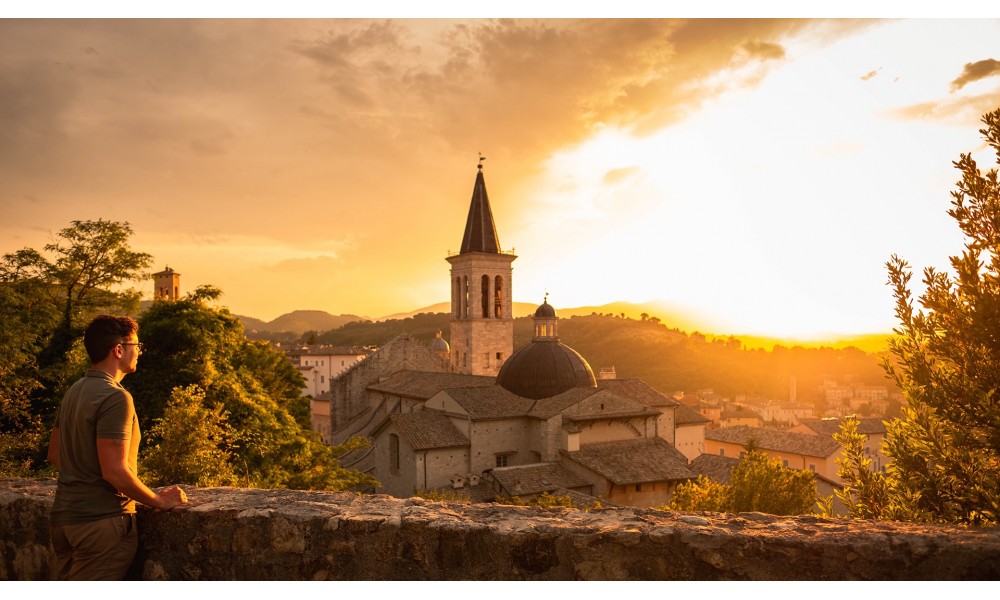
Spoleto. "city of art and music"
The influences of the Roman era are still evident, although Spoleto retains, with its characteristic narrow streets, the appearance of a medieval village. The Roman Theater, the Arch of Drusus and the early Christian Basilica of San Salvatore belong to the most ancient origins of Spoleto; but to dominate over all the monuments, the fortress built by Cardinal Albornoz in the second half of the fourteenth century. The Eroli Chapel and the Chapel of the Relics are two other attractions not to be missed: in the first you can admire beautiful frescoes by Pinturicchio; while the second houses the fourteenth-century statue of the Madonna and Child. In the center of the city stands the majestic Cathedral and a short distance away the Palazzo Arroni and the Church of Santa Maria della Manna d’Oro. Let's not forget the suggestive Ponte delle Torri, it is a huge work with ten arches that acts as a link between Colle Sant'Elia and Monteluco, measuring 236 meters long and about 90 meters high. The crossing consists of a road and a water channel, supported by pointed arches and stone pillars. It can be reached through a long panoramic walk around the Rocca Albornoz in Spoleto, located on the top of the hill above. It was a view that certainly impressed Wolfgang Goethe, a German writer and playwright of the eighteenth century, who dedicated a page of his "Journey to Italy". His walk through the city is commemorated by a plaque placed right next to the bridge. Crossing the bridge you can visit the Fortilizio dei Mulini and the Basilica of San Pietro.
Not only art, but Spoleto promotes important cultural events; first of all the Festival dei Due Mondi: a review of cinema, theater, art, music and ballet. It is one of the most popular events in this region and every year it manages to bring here millions of tourists arriving from all over the world. The first Spoleto Festival was organized in 1958 at the request of Gian Carlo Menotti, his idea was to unite two cultures and two different artistic worlds, the European and the American, dedicated a vast space to art and its forms of expression.
Let's move from knowing to pleasure. Although similar to Umbrian cuisine, Spoleto cuisine has retained its singular analogy. The traditional dishes enhance the local products and some of them still follow ancient recipes, handed down from family to family, from generation to generation: Spelled soup, Strangozzi alla Spoletina, with truffles or with asparagine, Risotto with strigoli, Fojata, Scrambled with truffles, Lamb alla cacciatora, Crescionda is a traditional sweet of the Spoleto area of ancient origins. Evidence regarding the existence and preparation of this appetizing dessert is lost in the Middle Ages when the sour and sweet contrast was preferred in the dishes.
The original recipe in fact included ingredients such as: pecorino cheese, eggs, chicken broth, grated bread, lemon peel, sugar, dark chocolate or bitter cocoa. Today crescionda includes combinations of "less risky" ingredients and is prepared with amaretti dark chocolate, lemon zest, eggs, sugar and flour.
Given the period, we offer you a Christmas recipe typical of the "L’attorta" area, also called serpentone; is a typical Umbrian dessert made up of a puff pastry filled with apples and other ingredients, rolled on itself in the shape of a spiral. In the most ancient recipes, apples were cooked. The recipes of the attorta vary from house to house, over time the recipe has been enriched with amaretti, mostaccioli and hazelnuts:
INGREDIANTS:
for the pasta: 500g of flour, 3 eggs, 100g of sugar, 10g of extra virgin olive oil, 20g of alchermes or rum, 300g of water; for the dressing: 1.5kg of ripe apples, 200g of sultanas, 200g of shelled walnuts, 200g of sugar, lemon peel, 50g of alchermes or rum, 100g of dark chocolate or cocoa.
PREPARATION:
On a pastry board, work the flour with the eggs, sugar, water and the liqueur, until a smooth but soft consistency is obtained; cover and leave to rest in a cool place for at least an hour. Meanwhile, simmer the peeled and thinly sliced apples with the sugar, grated dark chocolate, lemon peel and liqueur. After a few minutes, remove from the heat and allow to cool; when the mixture is at room temperature, add the finely chopped walnuts and raisins. With a rolling pin, roll out the dough until you get a thin, elongated sheet; place it on a sheet of baking paper, distribute the sauce evenly over it, roll the sheet lengthwise and lightly brush the surface with olive oil. Arrange the cake, rolled up in a spiral, in a pan and bake in the oven at 180 ° C for about 40 minutes, then take out of the oven, sprinkle with the liqueur and garnish with sugar. Recently the filling has been enriched with pine nuts, candied almonds and mostaccioli.
Have a good year!!