
"UMBRIA to visit and taste"
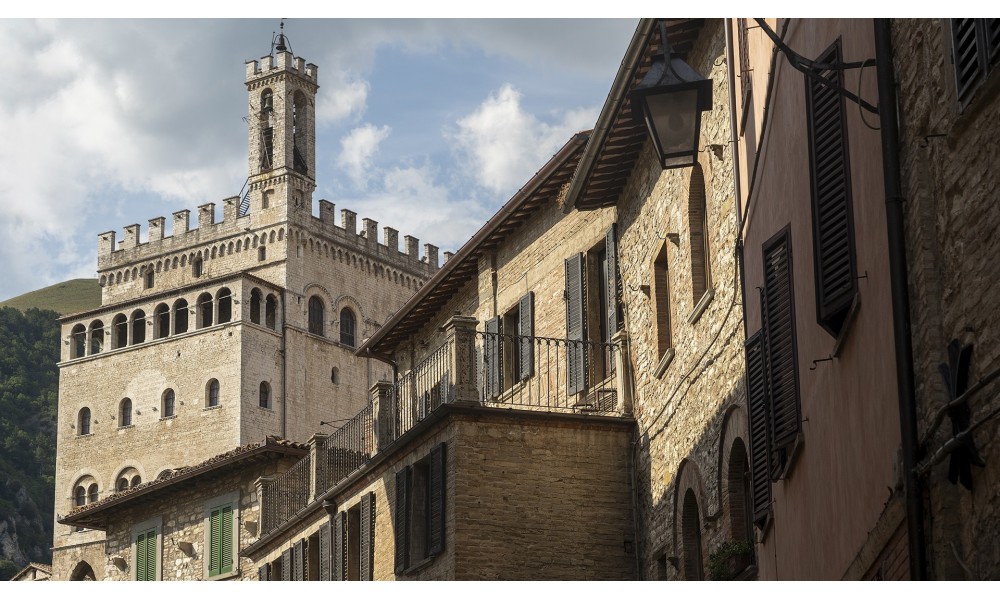
Gubbio "city of madmen" and "gray city"
Symbol of this proverbial 'madness', a fountain, known as the 'fountain of the mad'. It is actually called the Bargello Fountain, because it stands opposite the palace of the same name, an excellent example of Umbrian Gothic architecture: a well-preserved fourteenth-century building which houses the museum dedicated to the crossbow and is the seat of the Crossbowmen's Society. In front of it, on the square called Largo Bargello, there is the curious stone fountain. Sixteenth-century sculptural work, rebuilt in the second half of the nineteenth century, it is a fountain that allows you to get a 'madman' license. If you make 3 laps around it and you are sprayed - indeed, baptized - with its water, in the presence of a Gubbio, you can apply for a sort of crazy honorary citizenship, complete with a certificate. But be careful: it must be a citizen of Gubbio to do it for you if you are not local. The 'official' license is required from the Maggio Eugubino Association, committed to safeguarding the traditions of the Umbrian town.
The tradition is said to be linked to the famous Festa dei Ceri, the most popular folk event in Gubbio: according to some ancient documents, those who participated in it 3 consecutive times could request a sort of honorary citizenship. But why is whoever does it 'crazy'? It would be wrong to think that the 'madness' of the Gubbio is to be associated with the literal meaning of the term. In truth, it is said that the citizens of Gubbio are simply very ironic, unpredictable, funny, and therefore becoming an 'honorary madman' means sharing this verve with the Gubbio people.
The limestone blocks with which Gubbio was built, give the village the nickname of "gray city": it is the oldest center in Umbria that has preserved its medieval appearance, both in the buildings and in the streets. A worthy town in Umbria, Gubbio has a landscape that is as uniform as it is sublime: a repetitive but still wonderful landscape. Like Assisi, the history of this other city is also closely linked to the figure of St. Francis and in particular to the encounter with the wolf. The Church of San Francesco is the place where the wolf took refuge to spend the night. Starting from Piazza Grande, the main center of the city, a tour of the monuments, from the Palazzo dei Consoli to the Palazzo del Capitolo up to the Duomo and the Church of Santa Maria dei Servi, will allow you to learn about the history and legends of Gubbio.
Gubbio is considered as the "kitchen of the past" where the real protagonists were the hands and the fire in the fireplace, the cuisine of Gubbio is full of typical dishes that express the value and the indisputable flavor of the past such as the cereal soup and legumes (imbrecciata) and onions under the grill.
Another typical product is the Crescia al Panaro or Torta sul Panaro is a kind of focaccia that is used to accompany and which can be stuffed or can accompany local cold cuts and cheeses.
This is a poor product and of peasant origin, it is prepared simply with water, flour and yeast and is cooked under the ashes on the so-called “panaro” which is a circular wrought iron plate.
INGREDIANTS:
300g Flour 0
150 ml Water (lukewarm)
1 pinch Salt
8g Instant yeast for savory preparations
To make the Crescia al Panaro, place the flour in a fountain on a pastry board and put the water, yeast and a pinch of salt inside. Knead well, until a smooth and homogeneous mixture is obtained. Let it rest for about fifteen minutes, covered with plastic wrap.
TRADITIONAL COOKING ON PANARO: In the meantime that the dough rests, place the panaro upside down on the flame of the fireplace to heat it up. Roll out the crescia so that it fits inside the panaro itself, and in the meantime remove it from the heat to check if it is up to temperature. Throw a little flour on the panaro, when it becomes golden, it will be the right time to cook the crescia. Place the crescia on the panaro, prick it and let it cook for a minute, turn it over and cover it with ash. Place a little embers under the panaro to help cooking. Extract the crescia, only when the ash has withdrawn, beat, break with your hands and enjoy hot.